

Reality feels objective.
Independent.
As if it exists exactly the same way whether anyone is watching or not.
For centuries, this assumption went unchallenged. The universe was treated as a vast machine, running independently of human awareness. Observation was passive. Reality simply was.
Modern physics shattered that illusion.
At the deepest measurable level, reality behaves very differently. It responds. It changes. It waits. The act of observation itself alters what is observed. This phenomenon is known as the Observer Effect, and it forces a disturbing question:
What if reality does not fully exist until it is perceived?
What the Observer Effect Really Means
The Observer Effect is often misunderstood.
It does not mean that human thoughts magically create reality.
It means something far more unsettling.
At the quantum level, particles do not behave as solid objects. They exist as probabilities. Waves of potential. Only when measured or observed do they collapse into a definite state.
Before observation, reality is undefined.
After observation, it becomes specific.
This is not philosophy.
It is experimentally verified physics.
The universe, at its core, does not present fixed answers. It presents possibilities.
The Double-Slit Experiment and the Collapse of Certainty
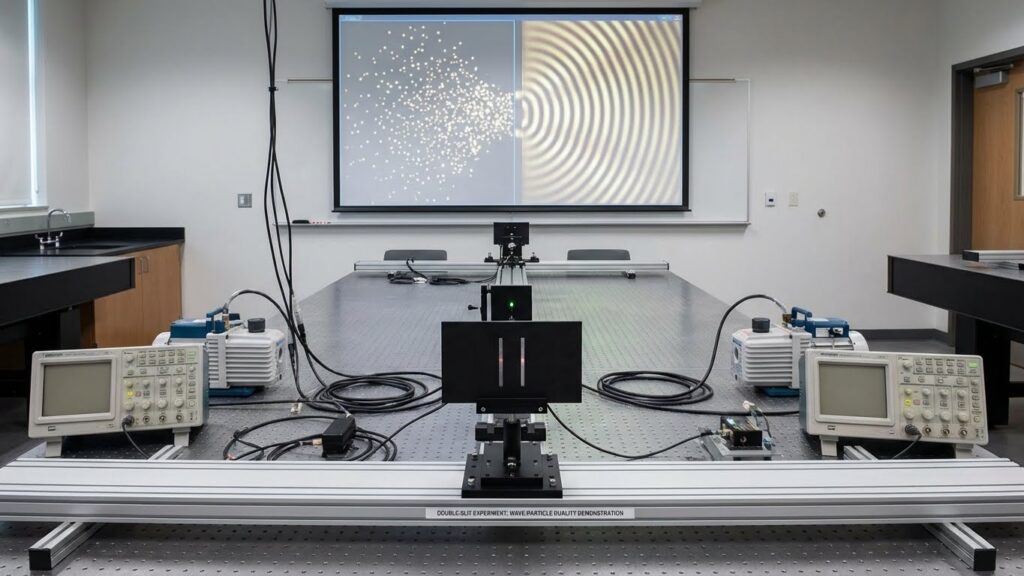
The most famous demonstration of the Observer Effect is the double-slit experiment.
When particles such as electrons are fired toward a barrier with two slits, they behave like waves, creating interference patterns. This happens even when particles are sent one at a time.
However, when detectors are placed to observe which slit the particle passes through, the interference pattern disappears. The particle behaves like a solid object instead of a wave.
The act of observation changes the outcome.
Reality behaves one way when unobserved, and another when observed.
This experiment has been repeated countless times, with the same result. The universe reacts to observation itself.
Observation Is Not Neutral
This discovery destroys the idea that observation is passive.
To observe is to participate.
Measurement is not a window into reality.
It is an interaction with it.
This forces a radical shift in understanding. Reality is not a finished product waiting to be discovered. It is a process that unfolds through interaction.
The observer is not separate from the observed.
Consciousness and the Question Science Avoids
Physics describes what happens, but avoids explaining why.
What qualifies as an observer?
Is it a machine?
Is it consciousness?
Is it awareness itself?
Experiments show that it is not human eyes that matter. It is information. When information about a particle’s state exists, reality collapses into form.
This raises a deeper question science is uncomfortable addressing.
Is consciousness fundamental?
This aligns directly with how perception is structured and limited →
The Saturn Matrix: The Black Cube and the Architecture of Limitation
Reality as a Rendered Experience
If reality only becomes defined when observed, then what humans experience may be more like a rendered interface than an objective world.
Much like a video game only renders what the player sees, reality may conserve complexity until interaction demands it.
This does not mean reality is fake.
It means reality is conditional.
Conditioned by observation.
Conditioned by perception.
Conditioned by awareness.
Why Humans Experience a Stable World
Despite this strange behavior at the quantum level, everyday reality feels stable and consistent.
This stability comes from filtering.
The human brain aggressively filters information, locking perception into a narrow bandwidth. This creates continuity, identity, and predictability. Without it, survival would be impossible.
But this filtering also hides deeper layers of reality.
These perceptual limits become clearer when explored through dimensional models →
13 Dimensions Explained: Why Reality Is Far Bigger Than Science Admits
Time, Identity, and the Observer
Observation also anchors identity.
Humans observe themselves as continuous beings moving through time. Memory stitches moments together, creating the illusion of a persistent self.
But if observation defines reality, then identity itself may be a construct maintained through continuous observation.
Without memory, identity dissolves.
Without observation, time loses meaning.
Reality, identity, and time may all emerge from the same mechanism.
Why This Feels Uncomfortable
The Observer Effect threatens deeply held beliefs.
It suggests:
- Reality is not independent
- Consciousness is not secondary
- Observation is creative, not passive
This destabilizes materialism. It blurs the line between subject and object. It implies that reality is participatory.
Not controlled by consciousness, but co-created through it.
Ancient Insight, Modern Language
Long before quantum physics, ancient traditions hinted at this idea.
Reality as illusion.
The world as appearance.
Awareness as fundamental.
Modern science did not invent these ideas. It rediscovered them, using different language and instruments.
What the Observer Effect Implies
If observation shapes reality, then:
- Consciousness is not a byproduct
- Reality is not fixed
- Perception is power
This does not grant unlimited control.
It grants responsibility.
Reality responds to interaction, not intention alone.
🎬 Watch the Full Visual Exploration
In this video, we visually explore the observer effect, quantum experiments, and why reality behaves differently when observed.
Final Reflection
Reality does not exist in isolation.
It exists in relationship.
The universe is not something you watch.
It is something you participate in.
The moment you observe, reality answers.
Are you ready to wake up?
Leave a Reply